← Back to gallery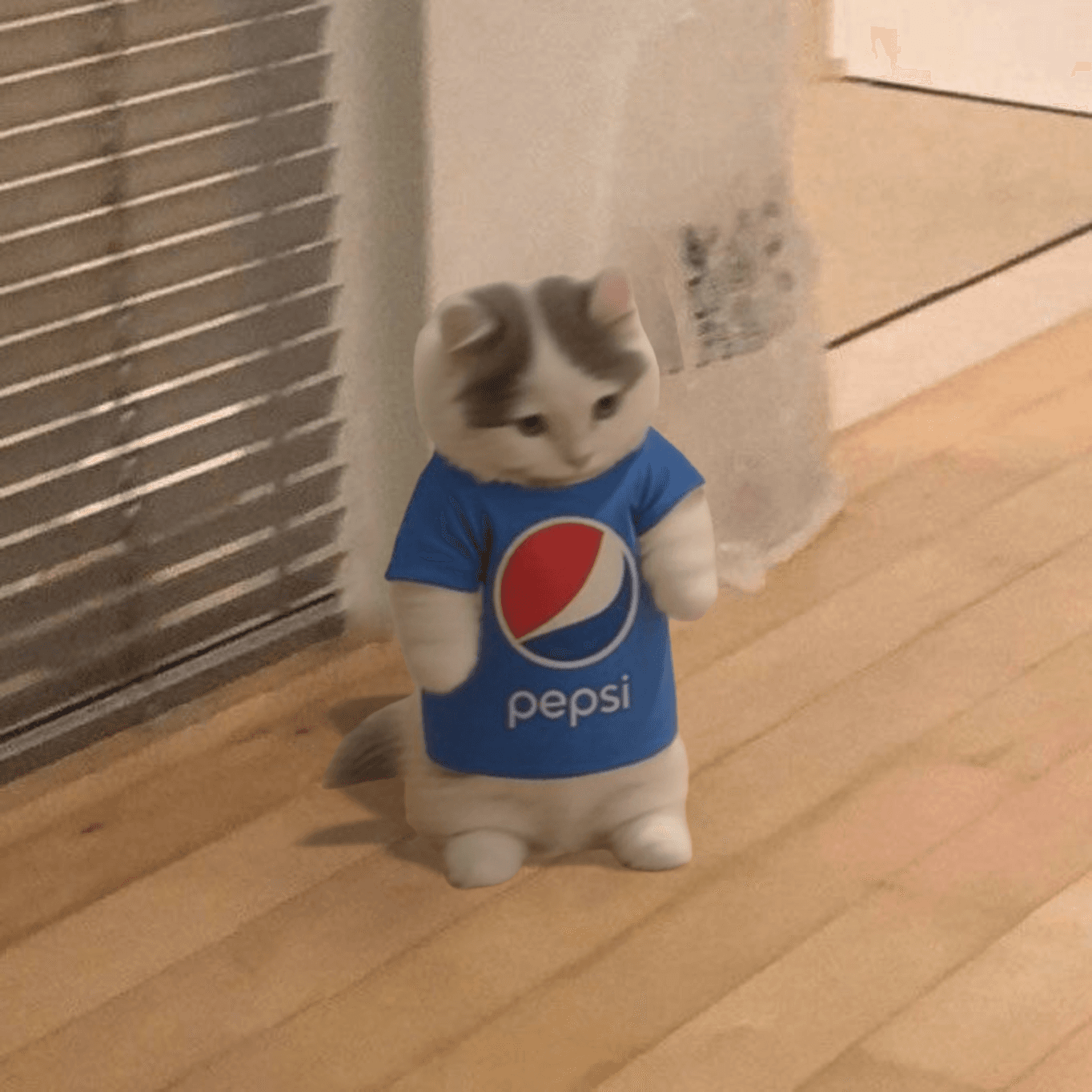
With Background PNG Only Meme PNG
Michi in Pepsi Can Suit
AI Generated: michi, hnddrwn, make a michi dressed as: A blue can of Pepsi is shown. The can features the Pepsi logo in red, white, and blue. The logo is circular and includes the word "PEPSI" in bold black letters. The can has a shiny metallic finish. The can is worn by a cat with fur that matches the blue color of the can. The cat's real head is visible from one opening at the top, and its real legs and paws are visible from the bottom. The can is soft, puffy, and stuffed. All hard features such as buttons, wheels, handles, screens, text, logos, and panels are sewn-on fabric pieces or embroidered patches. The can is designed to resemble a real Pepsi can.. COSTUME INSTRUCTIONS: The costume description above defines what Michi should wear. Recreate ALL mentioned clothing pieces, accessories, props, colors, patterns, and signature attributes as hand-drawn costume pieces fitted onto Michi the cat. If the description includes a full outfit (shirt, pants, shoes, hat, etc.) — draw every piece on Michi. If the description includes distinctive attributes (crown, weapon, cape, hairstyle, uniform) — recreate each attribute as a drawn prop or costume element on Michi. Match the described colors, patterns, and details as closely as possible in flat hand-drawn style. The goal is: someone seeing the result instantly recognizes who or what Michi is dressed as. UNCOVERED BODY PARTS RULE — MANDATORY: Any part of Michi's body that is NOT covered by costume must remain fully visible as original photo-real cat fur from the base Michi image. The costume only ADDS drawn clothing on top — it never removes, hides, or erases body parts that should still be showing. If Michi wears a shirt but no gloves, the paws must be fully visible as real cat paws. If Michi wears pants but no hat, the full head and ears must be visible as real cat. If a costume leaves the tail uncovered, the tail must be present and visible. Every uncovered area — face, ears, paws, legs, arms, tail, belly, chest — must show the original Michi photo-real fur, never be blank, missing, or cut off. Think of it as layering: start with the complete original Michi photo, then draw costume pieces on top. Whatever the costume doesn't cover, the original cat shows through completely. style card: GOAL: Keep cat exact size, proportions, fur from original base image. Maintain original background (room with wooden floor, white blinds) unchanged except for drawn props. Costume and props are hand-drawn black fineliner style with flat, noise-free colors. All uncovered body parts (arms, legs, paws, tail, face) remain photo-real fur from base cat, outlined in fineliner if needed. Poses adapted cat-like, never human anatomy. CRITICAL COSTUME SIZING RULE: Before drawing any costume, trace the cat's full body silhouette first. Every garment edge must align with or extend BEYOND that silhouette — never inside it. A shirt drawn on the cat must span the entire width of the cat's torso from edge to edge. Sleeves must be as thick as the cat's actual arms. Trousers must be as wide as the cat's actual legs. Hats must sit on top of the head at full head-width or wider. No garment may float smaller inside the cat's body outline like a sticker — it must wrap around the body as if the cat is physically wearing it. The costume silhouette should equal or exceed the cat's silhouette at every point of overlap. If the cat's belly is X pixels wide, the shirt across the belly must be ≥X pixels wide. Think of it as: draw the clothes ON TOP of the cat's edges, not INSIDE them. Oversized and baggy is always preferred over tight or small. LEG AND FEET SIZING — EXTRA IMPORTANT: Cat legs are SHORT, THICK, and WIDE — not thin like human legs. Cat paws are ROUND and BROAD. Every trouser leg, boot, shoe, sock, or leg covering must match the full width and height of the cat's actual chunky legs and big round paws. A single trouser leg must be as wide as the cat's entire thick fluffy leg — never drawn as a thin human-proportioned pant leg. Shoes and boots must be as wide and tall as the cat's real oversized paws, not tiny human-scale footwear. If drawing pants: each leg opening must be wide enough to contain the cat's full leg width with room to spare. Always reference the cat's real leg and paw dimensions and draw clothing that fits THOSE proportions, not human proportions. COSTUME ADAPTATION RULES: Translate human body proportions into cat body proportions. A long human dress becomes a shorter dress fitting the cat's compact body. Human-length sleeves become short sleeves fitting cat arms. Human shoes become wide chunky boots or coverings for big cat paws. Never stretch or distort the cat to match a human body shape — always reshape the outfit to fit the cat. Keep the costume's identity (colors, style, key details) but adapt every measurement to the cat's real anatomy. RENDER: 1:1 ratio. Slightly blurry low-res photo look for background and cat. Costume/props clean, flat-colored, noise-free, hand-drawn look. Fur areas always original cat colors and texture from base image. Smooth black fineliner outlines for all drawn elements. Flat fills max 2-3 shades per costume element. Cat anatomy and fluffiness preserved at all times. AVOID: Human skin or anatomy on cat. Photographic noise inside drawn costume elements. Changing cat size or position in frame. Any costume piece drawn smaller than the cat's body underneath it. Garments that look like miniature overlays or tiny stickers placed on the cat rather than full-sized clothing the cat is wearing. Clothing outlines that fall inside the cat's body silhouette instead of on or outside it. Thin human-proportioned trouser legs, skinny boots, or small shoes on the cat's thick wide legs and big paws. Drawing leg clothing at human leg width instead of cat leg width. Removing, hiding, erasing, or cutting off any body part that the costume does not cover — all uncovered cat parts must remain fully visible from the original Michi base image.. CRITICAL: The cat must be exactly 68% of the image height. Cat's face must be photorealistic. Only the costume/props are hand-drawn overlays.